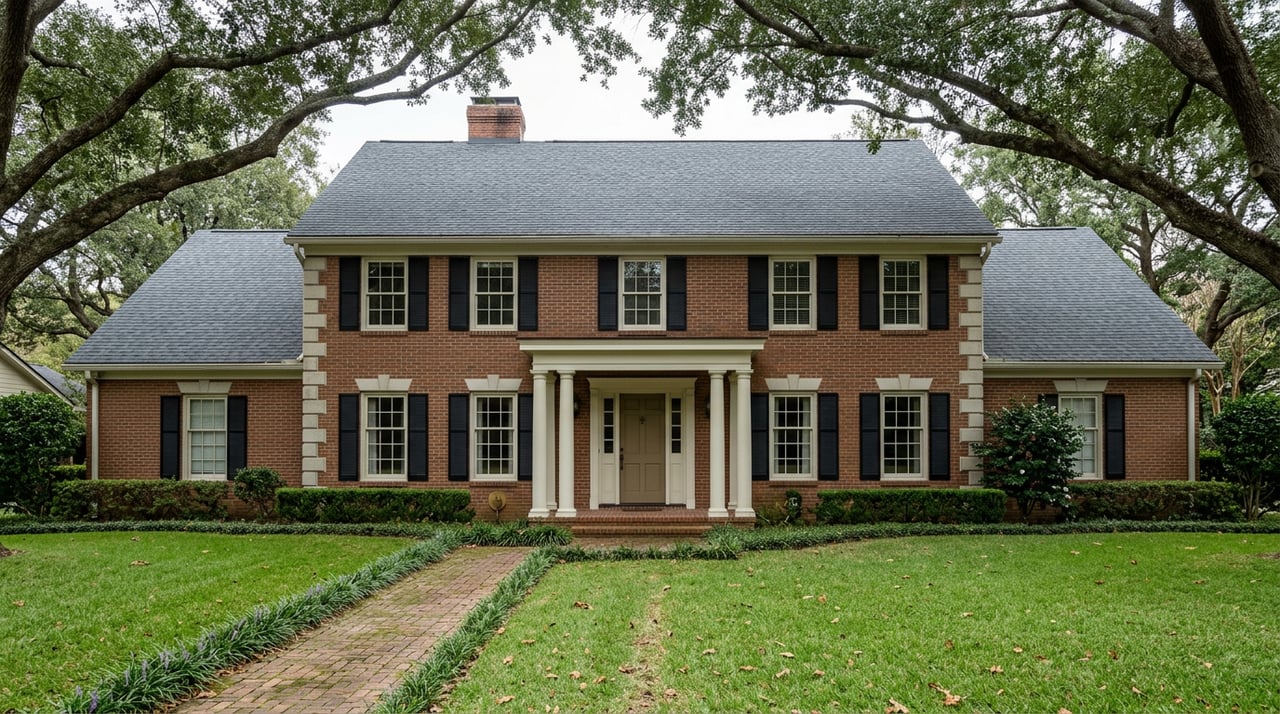
A 6,000-square-foot lot on Winnetka Street lists for $149,900. A few streets over on Fernwood Drive, a five-bedroom, five-and-a-half-bath house built in 2026 on a 9,450-square-foot lot is priced at $1,750,000, or $389 a square foot. Both are active listings in Riverside Terrace as of early August 2026, and both sit within blocks of restored Art Deco and Mid-Century Modern originals from the 1930s and 40s.
If you assume that spread exists because Riverside Terrace is a "historic neighborhood," you are working from the wrong model. Houston does not treat Riverside Terrace as a historic district. A district was proposed in 2022, but none was created. What protects a given block today, if anything does, was built afterward, by residents, one petition at a time. That distinction determines whether the empty lot next to the house you are considering can legally become three townhomes or a 2026-spec build like the one on Fernwood. The applicable restrictions therefore depend on the block and should be checked for the property you are considering.
The Historic District That Never Happened
In December 2021, a homeowner petitioned the city to initiate what would become the "First Riverside Terrace Historic District." The original boundary covered 51 homes, according to KHOU's reporting on the fight. Houston's Historic Preservation Ordinance requires at least two-thirds property owner support for a district to pass, and when the vote inside that original boundary fell short, the planning department redrew the lines down to a 19-tract footprint to reach the threshold. The city's own designation report shows that of those 19 tracts, 16 structures, or 84.21 percent, qualified as contributing, with one tract vacant.
The boundary redraw drew objections from residents.
"Their property rights should not be usurped from them by an employee of the city."
That is neighborhood spokesperson Tomaro Bell, speaking to Fox 26 as the fight escalated. The concern was not aesthetic. According to Preservation Houston's guide, historic district status in Houston triggers Certificate of Appropriateness review for exterior changes, additions, and demolitions, a cost and process burden that longtime residents worried would fall hardest on families who could least afford it. Riverside Terrace carries a specific version of that history. Homes here sold to Jewish families in the 1920s and 30s at a time when River Oaks would not, and the neighborhood transitioned into an affluent African-American community by the 1950s and 60s. A designation process that threatened to price out longtime owners in a neighborhood built on exactly that kind of access carried weight the city's standard process did not account for.
Mayor Sylvester Turner withdrew the plan in June 2022, citing a lack of neighborhood support, as Community Impact reported at the time. No historic district exists in Riverside Terrace today.
What Actually Protects the Neighborhood Now
With the citywide overlay dead, protection in Riverside Terrace runs through the Riverside Civic Association, and it works differently than a historic district in a way every buyer should understand before comparing lots.
Instead of triggering city review for exterior changes, the association petitions block by block for deed restrictions on minimum lot size and setbacks. Where successful, these restrictions bar subdividing a lot for townhomes or other multifamily product and require new construction to sit at least 25 feet back from the street. The association's own description of the strategy is direct:
"Minimum-Lot-size restrictions and setbacks are the low-hanging fruit."
More than a decade ago, that petitioning effort covered close to 70 percent of the blocks south of Southmore. In recent years, the association has added roughly ten more blocks. That leaves a meaningful share of Riverside Terrace, by the association's own accounting, still unprotected.
This is the mechanism that matters more than the neighborhood's historic reputation. A block with an active deed restriction functions something like a mini zoning ordinance, controlled by the residents who petitioned for it. A block without one has no equivalent backstop. The same street can look identical from the sidewalk and carry entirely different redevelopment risk depending on whether a restriction was ever filed.
Reading the Current Listings Through That Lens
| Address | Section | Lot Size | Price | Product Type |
|---|---|---|---|---|
| 4923 Winnetka St | Sec 11 | 6,000 sq ft | $149,900 | Buildable lot |
| 2313 Wichita St | Sec 01 | 8,450 sq ft | $625,000 | Buildable lot |
| 4004 Fernwood Dr | Sec 18 | 9,450 sq ft | $1,750,000 | New construction, built 2026, $389/sq ft |
That the Winnetka lot lists for under $150,000 and the Fernwood house a few sections over lists for nearly twelve times that is not a contradiction. It is what a neighborhood looks like when redevelopment is legally straightforward on some blocks and constrained on others. Spec builders and buyers looking to build custom are drawn to the sections where nothing stops a teardown-and-rebuild. Buyers looking for the restored original, or the block that will still look the same in ten years, are paying for something the market price alone does not disclose: whether that specific block was ever petitioned.
That Winnetka lot, as it happens, is listed by our own Karen Wells here at RE/MAX Premier, which is one reason we spend as much time on the civic association's petition maps as we do on the comparable sales.
Preservation Is Also Happening Without a Mandate
The absence of a historic district has not stopped private restoration. Roberts Markland LLP, a Houston law firm, has spent the past several years acquiring and restoring historic homes on Riverside Drive for use as office space. As of an April 2025 announcement, the firm's third such property sits at 2623 Riverside Drive, alongside earlier acquisitions at 2555 N. MacGregor Way and 2617 Riverside Drive, bringing its total to eight historic properties under restoration on that stretch.
There is also larger capital circling the area. KHOU reported in June 2026 on a proposed $20 million redevelopment covered by the Houston Business Journal that could add new attractions to the neighborhood. Nothing about that proposal is finalized, but it is one more signal that Riverside Terrace's character conversation is not settled. Whatever gets built next will be shaped by the same block-level restriction map, not by a historic overlay that does not exist.
Before You Write the Offer
If you are comparing Riverside Terrace against other Inner Loop options, the median price you already found on a portal will not tell you any of this. Before you get attached to a specific address, ask:
- Is this block one of the roughly 70 percent south of Southmore with a filed minimum-lot-size and setback restriction, or one of the blocks the civic association has not yet reached?
- Does the restriction, if one exists, actually cover the adjacent vacant lot, or only the block face your house sits on?
- Has the civic association added protection to this section in the past few years, or is the map you are looking at out of date?
- Was this address ever inside the original 51-home historic district boundary before it was redrawn down to 19? Some records may still reference the larger footprint even though it never passed.
Common Questions
Does Riverside Terrace have a historic district? No. The city considered one in 2022, reduced the proposed boundary from 51 homes to a 19-tract footprint to meet the required two-thirds support, and Mayor Turner withdrew the plan in June 2022 after it became clear broader neighborhood support was not there.
Are all of Riverside Terrace's blocks protected from teardowns? No. Deed restrictions on minimum lot size and setbacks cover close to 70 percent of blocks south of Southmore, with roughly ten more added in recent years. That leaves a real share of the neighborhood without this protection.
Can new construction go up next to a 1930s or 1940s original? Yes, and it already has. The 2026-built new construction currently on the market on Fernwood Drive sits within the same neighborhood as restored originals from the 1930s and 40s, which is exactly what you would expect where lot subdivision and setback rules are not universal.
If you are comparing Riverside Terrace against other Houston neighborhoods and want the actual restriction status on a specific block before you make an offer, RE/MAX Premier Luxury Collection can pull the civic association's petition history alongside the deed record for that address. Schedule a confidential strategy consultation to discuss what those records mean for your plans.
This article is general information, not legal, tax or financial advice. Consult a qualified professional about your situation.
